
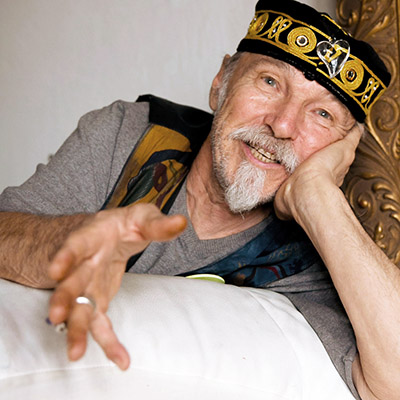
Lubo Kristek’s Life
Kristek’s life story and his art are inseparable.
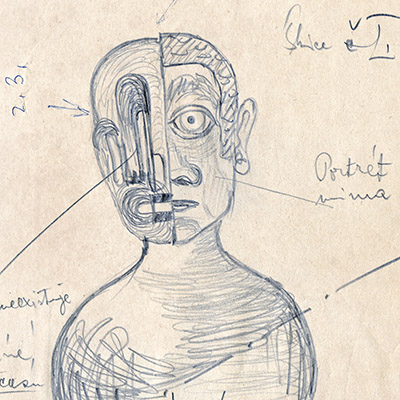
Flashes of fate
Sketches as records of the first ideas behind future works.
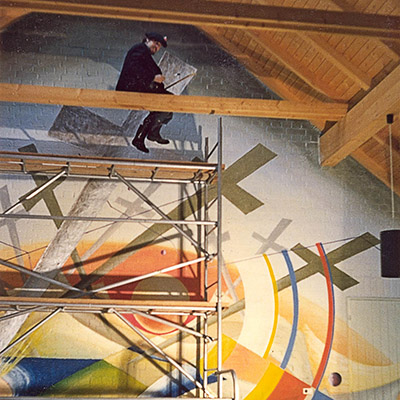
Public artworks
Documentation of Kristek’s artworks in public spaces across Europe.
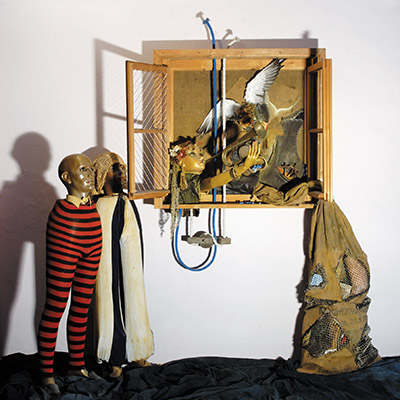
Oeuvre
A retrospective of Kristek’s extensive oeuvre.
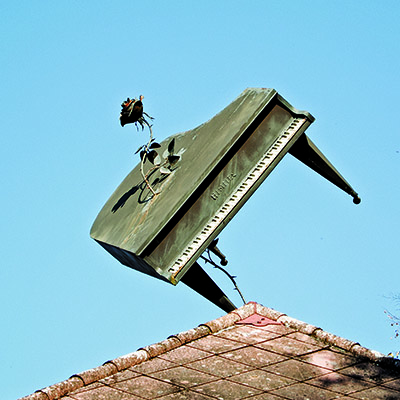
Symbols
Symbols and nooks of Chateau Lubo – testimonies to Kristek’s inner worlds.
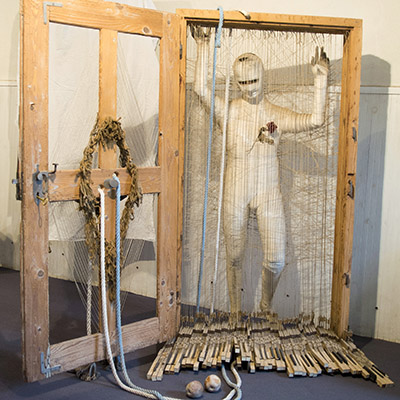
Relics from happenings
Events whose resonances became embedded in the emerging works of art.
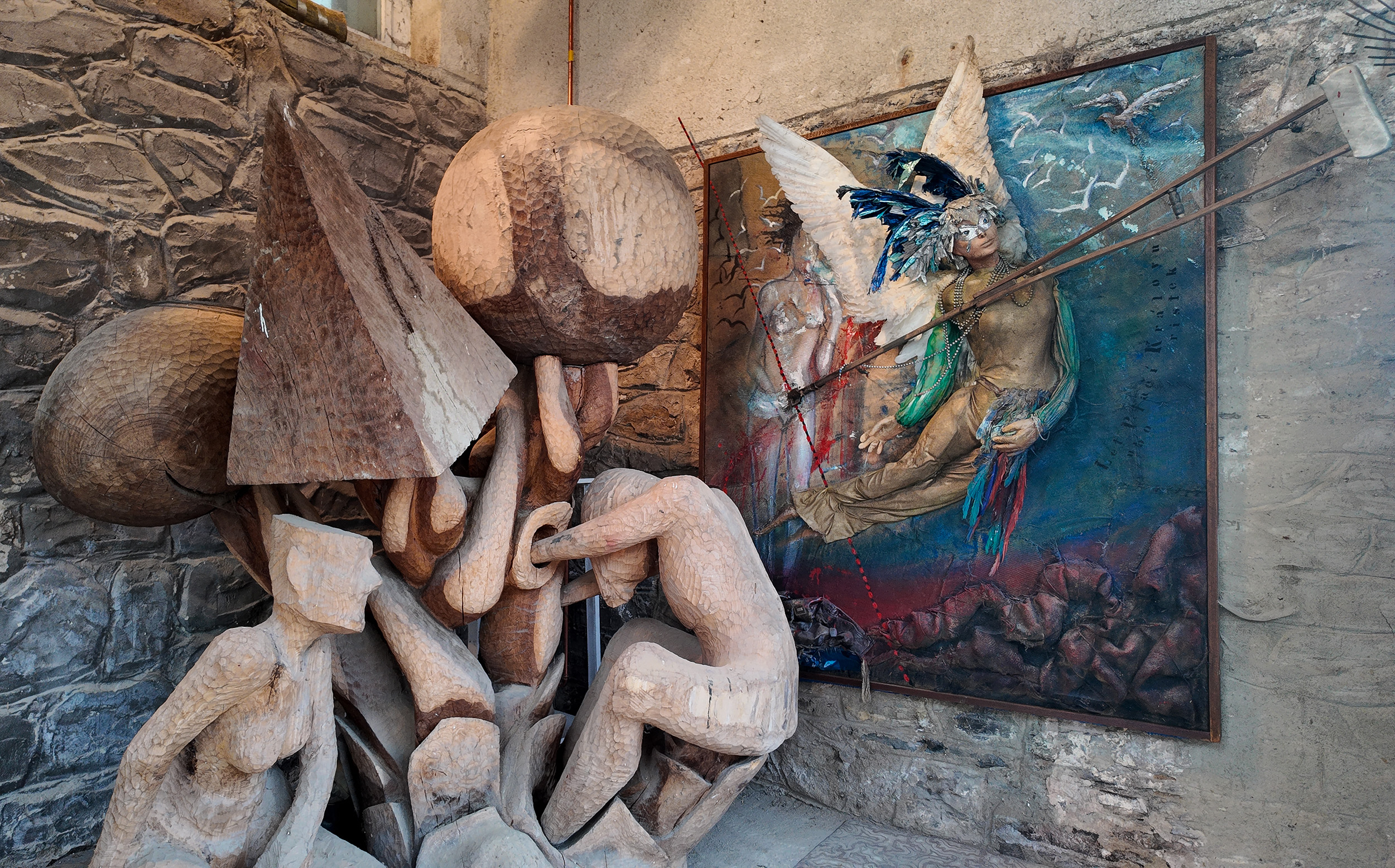 Oeuvre
Over more than six decades, Lubo Kristek’s artistic practice has evolved and acquired new layers without ever losing its inner coherence. The museum allows visitors to trace how the individual phases of his work intersect and build upon one another – from his early existential themes to his current creations, which continue to emerge directly at Chateau Lubo (Zámeček Lubo).
In the 1960s, Kristek created his first assemblages, imbued with existential themes. During this period, he organized artistic gatherings in his family home in Hustopeče, bringing together music, visual art, and ballet. Following his emigration to Germany in 1968, his work began to express an increasingly explicit critique of contemporary society. The relief painting Czech Polka (1972) created in response to the suppression of the Prague Spring, attracted attention even in the Swiss press. The 1970s saw the emergence of his first monumental works for public and sacred spaces. During the 1980s, Kristek travelled extensively throughout Europe, creating land-art assemblages from found materials. Works such as Christ Made of Barbed Wire (1983) and Sea Horse (1986) bear witness to the blind alleys and contradictions of the era in which they were conceived.
As a sculptor, Kristek works much like a medieval craftsman, personally welding, grinding, and hammering his sculptures. His freestanding works, particularly Monument to the Five Senses (1991) and Tree of the Wind Harp (1992), have been compared to those of Mikuláš Medek, Max Ernst, and Salvador Dalí, whose studio Kristek visited during the 1970s. Since the 1990s, silver has become an increasingly prominent theme in his work. For nearly four decades, he has been developing a cycle of small silver sculptures that symbolise the transformations of human suffering and faith.
Assemblage remains the defining feature of Kristek’s oeuvre, both as a technique and as a conceptual principle. Fragments of found objects, each carrying its own history, acquire new meaning and identity within a new work. Kristek applies this method in small-scale sculpture, monumental installations, and happenings alike. The same principle of layering, transformation, and the creation of new connections permeates the exhibition itself, which continues to grow year by year through the addition of newly created works.