
Lubo Kristek’s Life
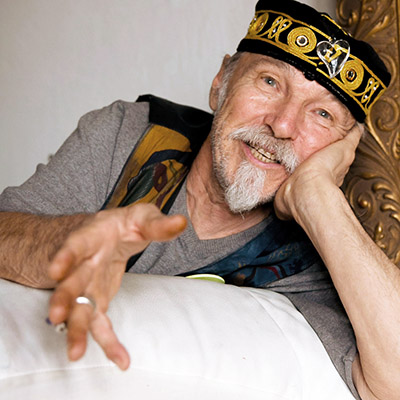
Kristek’s life story and his art are inseparable.
Flashes of fate
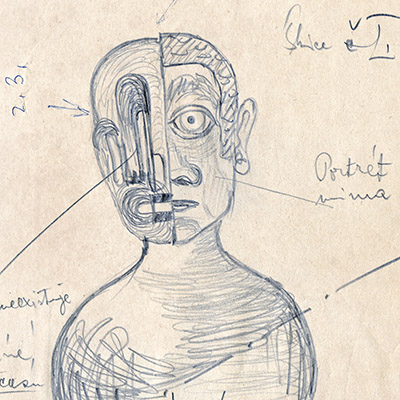
Sketches as records of the first ideas behind future works.
Public artworks
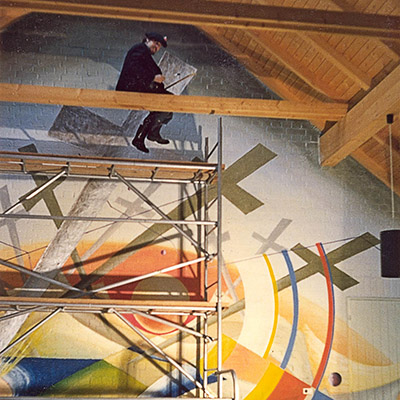
Documentation of Kristek’s artworks in public spaces across Europe.
Oeuvre
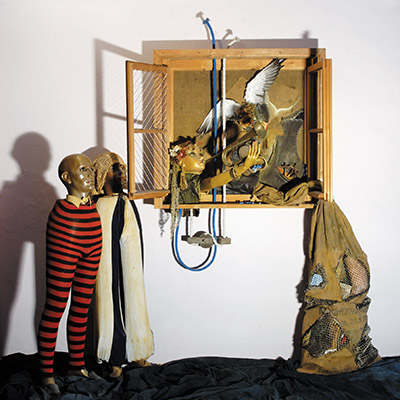
A retrospective of Kristek’s extensive oeuvre.
Symbols
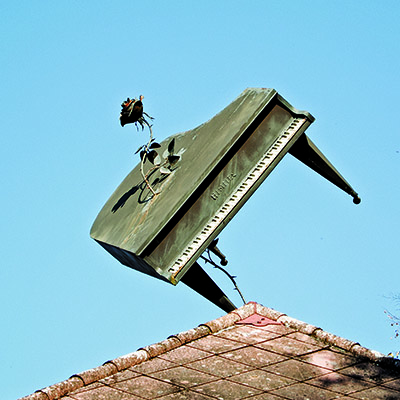
Symbols and nooks of Chateau Lubo – testimonies to Kristek’s inner worlds.
Relics from happenings
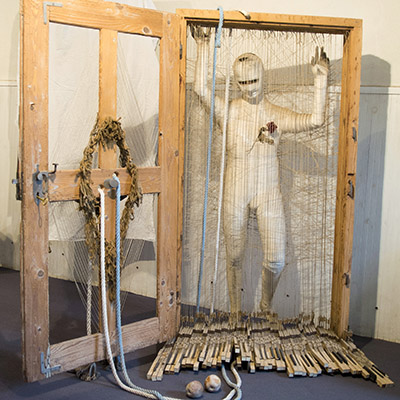
Events whose resonances became embedded in the emerging works of art.
 Public artworks
For many decades, Lubo Kristek has created not only in the studio, but also within landscapes and urban environments, where his sculptures, assemblages, and monumental works enter into a dialogue with public space. The museum at Zámeček Lubo documents works he has left across a number of European countries – including Germany, Austria, Italy, Slovakia, and the Czech Republic – and reveals how his artistic language evolved in response to the places, landscapes, and historical contexts in which it was situated.
In Landsberg am Lech, Germany, he created the sixteen-metre-high sculpture Tree of Knowledge (1981), which rises through three floors of the Ignaz Kögler Gymnasium to a skylight in the roof. For the Neues Stadtmuseum in the same town, he produced the metal sculpture Monument to the Five Senses. Since 1988, the bronze fountain Drinking has stood in the spa town of Greifenberg, while the chapel in Penzing houses the monumental altarpiece Transcendental Composition between Suffering and Hope.
Kristek’s most extensive project in public space is the Kristek Thaya Glyptotheque, an artistic and philosophical pilgrimage route created along the River Dyje between 2005 and 2006. Eleven sculptural stations connect five regions and three countries – the Czech Republic, Austria, and Slovakia – into a single artistic and landscape ensemble. Kristek selected locations where the genius loci spoke to him most strongly, creating a natural gallery in which visitors move through the landscape as naturally as the waters of the Dyje flow through it.
Lubo Kristek even transformed his own house into a monumental habitable assemblage. The result is Kristek House in Brno, inspired by Albert Camus’s The Myth of Sisyphus. Another significant influence was Kristek’s encounter with Jiří Voskovec in Los Angeles during the 1970s. Kristek House later became the setting for a film about the artist’s life and work and is regularly opened to the public as part of the Open House Brno festival.
The photographic and textual documentation presented at the Lubo Kristek Museum offers visitors an opportunity to explore works that would otherwise require a journey across Europe. For Kristek, public space has always been far more than a mere site of installation; it forms an integral part of the artwork’s meaning, a place where art encounters landscape, history, and everyday life.