
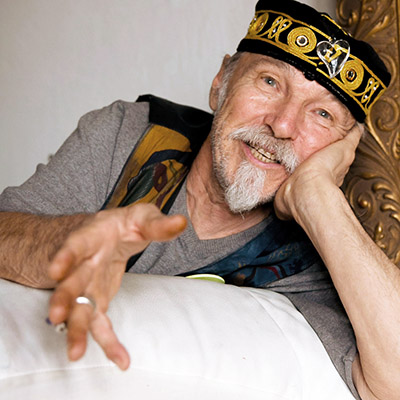
Lubo Kristek’s Life
Kristek’s life story and his art are inseparable.
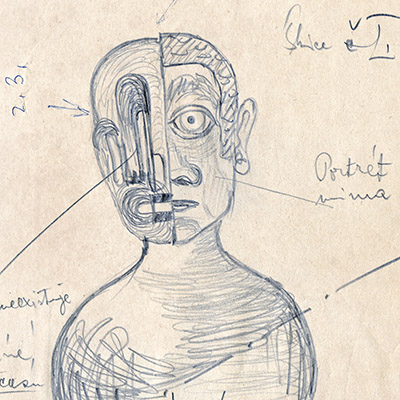
Flashes of fate
Sketches as records of the first ideas behind future works.
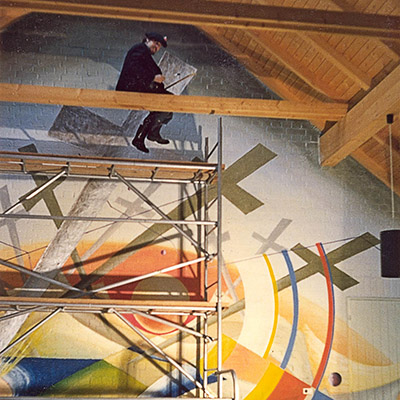
Public artworks
Documentation of Kristek’s artworks in public spaces across Europe.
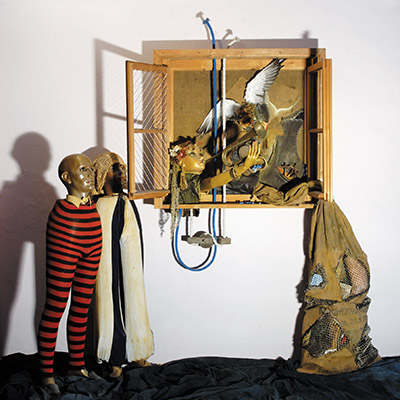
Oeuvre
A retrospective of Kristek’s extensive oeuvre.
Symbols
Symbols and nooks of Chateau Lubo – testimonies to Kristek’s inner worlds.
Relics from happenings
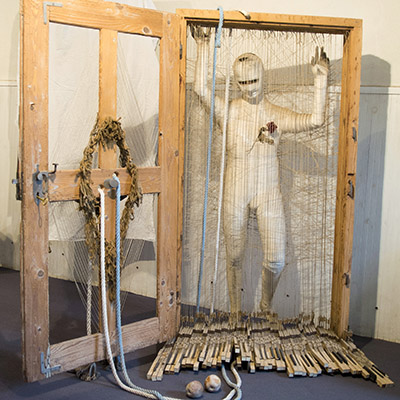
Events whose resonances became embedded in the emerging works of art.
 Symboly
Chateau Lubo (Zámeček Lubo) in Podhradí nad Dyjí is not merely the home of a museum – it is itself one of Lubo Kristek’s works of art. Its façade and interiors are permeated with symbolic motifs, assemblages, and artefacts that draw on Surrealism, mythology, and spiritual themes. A visit to Zámeček Lubo thus becomes a journey into the artist’s inner world, where every corner carries its own meaning.
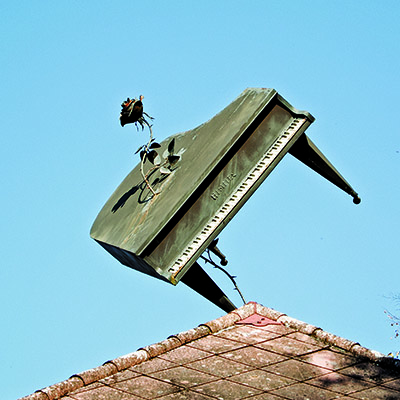
The most striking symbol of the site is a grand piano balanced on a single leg atop the roof – a sculpture entitled The Divine Ephemerality of Tone (1994). Throughout his life, Kristek has explored the motif of forms intertwining, merging, and giving rise to one another. The piano, from which a rose appears to grow, has become the emblem of Chateau Lubo.
In the garden, visitors can still see the farm wagon on which Kristek was literally brought back to the Czech Republic on the night of 31 July 1994, after years of exile in Germany. This symbolic homecoming marked the beginning of the happening Mythological Landscape No. 94: A Cart Full of Tones, or Assemblages in a Castle Ruin. The following morning, the writer Jaromír Tomeček ceremonially unveiled The Divine Ephemerality of Tone. Together, the wagon and the piano commemorate the moment when, after decades of travelling the world, the artist returned home, decided to stay, and continued his creative work here.
Another symbolic site – and today something of a place of pilgrimage – stands in front of Chateau Lubo: a sculpture bearing the enigmatic title Cosmically Timed Parapyramidal Potency. Its very name invites personal interpretation, reflecting Kristek’s characteristic approach to the viewer. He has never expected passive observation; instead, he encourages visitors to enter actively into a symbolic language that each person interprets through their own experience and imagination.
The hidden corners of Chateau Lubo bear witness to Kristek’s conviction that a symbol is always more than mere decoration. It is a gateway to an inner world that remains open to anyone willing to step inside.